Elon Musk Asks if Ambani Is India’s Real Boss
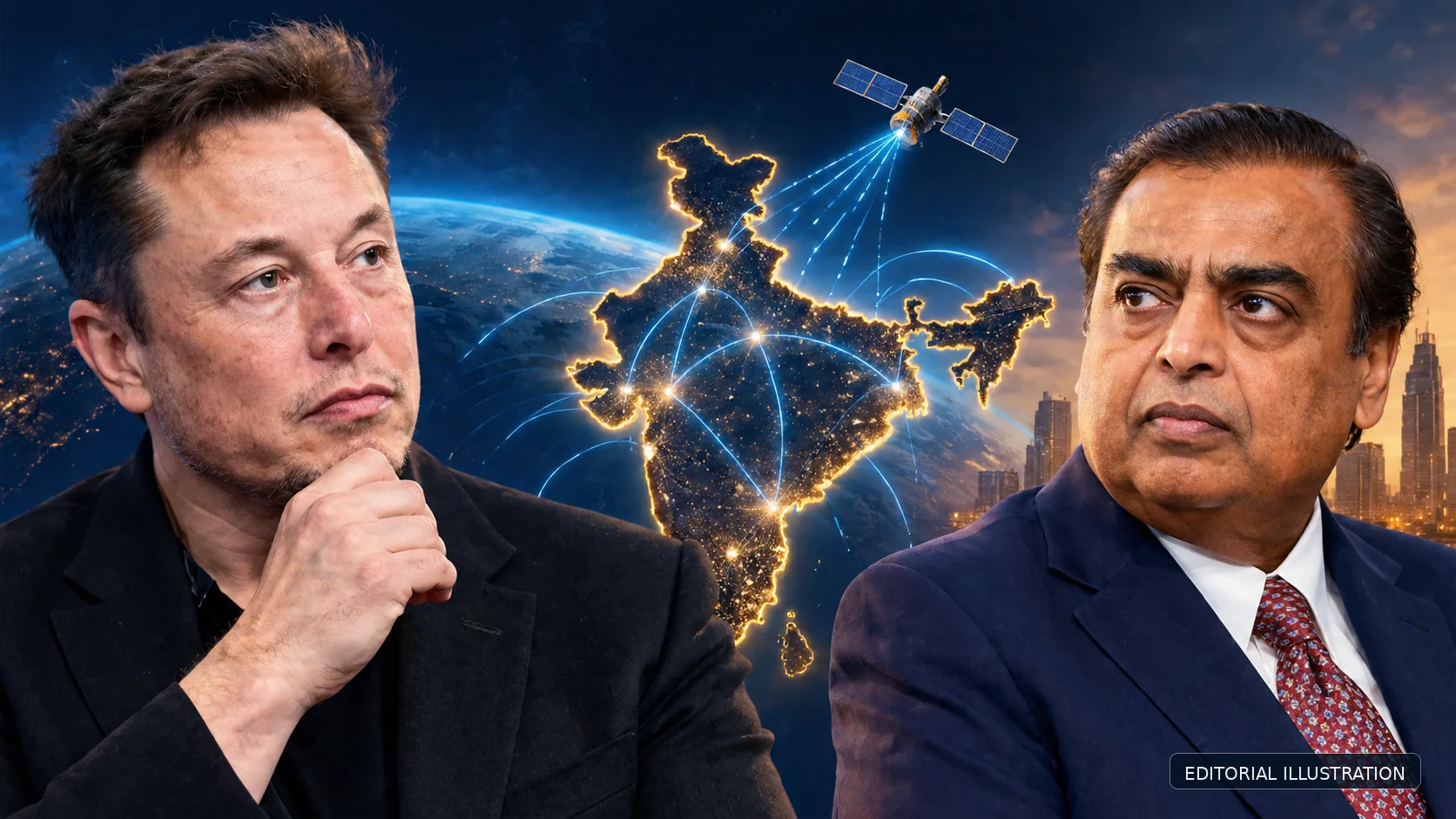
The question that pushed Starlink into India’s political spotlight
Elon Musk turned a long-running satellite-internet approval dispute into a viral political argument on October 8, 2026, when he publicly asked whether Mukesh Ambani was the “real boss of India.” The SpaceX founder was criticizing the pace of regulatory clearances for Starlink, his company’s satellite broadband service. His remark drew a response from opposition leader Rahul Gandhi, a government rebuttal, and another sharply worded Musk post the following day. It was a question about business influence, not an announcement about India’s government.
The central issue is easier to understand than the social-media exchanges suggest. Starlink wants to sell internet access in India. Regulators say satellite operators must satisfy national-security requirements and obtain spectrum before service can start. Musk alleges that powerful commercial interests are obstructing competition. India’s government rejects that explanation. Nothing in the reporting reviewed for this article establishes that Ambani personally ordered a regulator to delay Starlink.
What Elon Musk said on October 8
Musk argued on X that Starlink had spent years trying to meet Indian requirements and that the company operated, or was authorized to operate, in numerous other countries. He then asked whether Reliance Industries chairman Mukesh Ambani was the country’s real decision-maker. The question mattered because Ambani’s Reliance Jio is a major telecommunications provider, while Starlink would introduce a different way of delivering broadband to customers, particularly in difficult-to-reach areas.
The comment followed an earlier Musk complaint about unnamed “oligarchs” allegedly trying to protect their position in the market. The accusation was Musk’s view of the dispute, not a finding announced by a court or telecom regulator. That difference can get lost when a provocative sentence circulates by itself on social media. The headline is real; the inference that Ambani secretly controls India’s licensing authorities has not been proven.
TechCrunch’s October 8 report documented the opening exchange and the Indian government’s response. Reuters reported on October 9 that Musk had offered no evidence to support his suggestion of improper influence.
How Rahul Gandhi turned the exchange into a political story
Rahul Gandhi, India’s leader of the opposition in the Lok Sabha, joined the conversation after Musk questioned Ambani’s power. Gandhi welcomed Musk to the Indian political debate and suggested he might discover another powerful figure. His remark was widely read as a criticism of the closeness between business power and elected politics. Musk acknowledged the response. The brief exchange was enough to move the argument beyond business pages into political news coverage.
Gandhi’s response did not provide proof of licensing interference, and a social-media reply is not a regulatory decision. The exchange did, however, illustrate why the Starlink question is politically sensitive. On one side is a high-profile American technology entrepreneur asking for access to a large market. On the other are Indian officials tasked with evaluating foreign satellite networks, and domestic companies that already serve enormous customer bases.
Readers can find the contemporary exchange and reactions in The Indian Express’s coverage. The parties did not announce an agreement in those posts, and none of the messages changed the legal steps Starlink needed to complete.

Why Starlink’s Indian launch has been delayed
Satellite broadband is not the same as opening another ordinary mobile-phone shop. A constellation of orbiting satellites provides connectivity to ground terminals, but commercial service still operates within a country’s communications and security laws. Regulators must consider who can access network traffic, how lawful orders are handled, how spectrum is shared, and how customer data and critical services are protected. Those issues take on particular importance when a service is delivered by a foreign-owned satellite network.
In an official October 8 statement, India’s Ministry of Communications said it had granted relevant satellite-service licences to three operators. It explained that security assessment was under way for all three and that eligible operators could move on to spectrum assignment after the assessment. The ministry described the companies as being at broadly the same regulatory stage and denied that the process was discriminatory.
That distinction resolves some apparent contradictions in the headlines. A company can possess an authorization and still be unable to sell its service until subsequent requirements are complete. Saying “Starlink has a licence” does not necessarily mean customers can subscribe immediately. Saying “Starlink is not live” does not, by itself, prove that another business blocked it.
What the Indian government said about monopoly claims
Telecom Minister Jyotiraditya Scindia pushed back publicly on the suggestion of a monopoly, saying the country did not allow monopolies in any sector. The ministry’s written response emphasized uniform rules and security checks, while Musk continued to argue that the long wait was unreasonable. These are competing accounts of why the process has taken so long. The official explanation describes the procedures being applied; Musk’s posts challenge whether those procedures are being used fairly.
For a reader trying to evaluate the claims, two questions are separate. First, what approvals are legally required? India has explained the sequence of licensing, security review and spectrum assignment. Second, has anyone deliberately interfered with that sequence? The public sources linked here do not establish such interference. A careful news report should preserve that uncertainty rather than using the word “exposed” or claiming an invisible conspiracy has been confirmed.
The complication: Jio and Starlink had already announced cooperation
One detail missing from many viral summaries is that Reliance Jio and SpaceX announced an agreement in March 2025 to offer Starlink services to Jio customers in India, subject to the necessary authorizations. Reliance’s own press announcement described plans for equipment availability and customer support through Jio’s retail network.
This does not rule out later commercial disagreements, nor does it prove the companies remained aligned in October 2026. It does show that the relationship has been more complicated than a simple permanent rivalry. A retail distribution partnership can coexist with competition over infrastructure, regulatory conditions or the share of future broadband subscribers. For that reason, both the earlier agreement and the newer conflict belong in a complete account.
Why the issue matters to ordinary internet users
Starlink’s proposition is most relevant where laying fiber is difficult or where reliable terrestrial connections are unavailable. In theory, satellite networks can provide another option for rural households, schools, businesses, ships or remote worksites. They can also support connectivity after some disasters, although local rules, equipment availability and power remain practical constraints. Musk has emphasized educational access and opportunities for small businesses as reasons to allow the service to enter India.
Those potential benefits do not answer what Starlink would cost or how it would perform for an individual Indian household. The available reporting does not establish a final retail price, a nationwide launch date, guaranteed speeds or a comparison showing that it would beat every existing connection. Consumers would need actual Indian plans, taxes, hardware charges, service maps and measured reliability before making a purchase decision.
Regulators, meanwhile, have an obligation to examine public-safety and communications-security concerns even when a service promises better coverage. Competition and compliance are not mutually exclusive goals. The policy question is whether security rules are clear, consistently applied and completed within a defensible timeline.
What happened next: the “Prime Minister Ambani” follow-up
On October 9, Musk escalated his criticism by sarcastically addressing Ambani as “Prime Minister Ambani.” That later statement created a second round of headlines and social-media reactions. It did not mean Ambani had become prime minister; Narendra Modi remained India’s elected head of government. The phrase was a rhetorical attack on what Musk portrayed as undue corporate influence.
Our separate explainer on the “Prime Minister Ambani” remark covers the second post, the licensing requirements, the earlier Jio–SpaceX agreement and the October 13 developments. Treating the two moments as distinct makes the timeline much clearer.
Latest development and what to watch
By October 13, the dispute had attracted a new intervention: the Swadeshi Jagran Manch, an organization associated with the broader Hindu nationalist movement, urged India to block Starlink on national-security grounds. Reuters reported the call, but it should not be confused with a final government decision to ban the service.
The next meaningful milestones are official confirmation of security assessment outcomes, the spectrum-assignment process, any revised terms of cooperation between providers, and an actual commercial launch announcement. Viral posts may change the public conversation, but published regulatory actions will determine when customers can connect.
The bottom line
Elon Musk really did question whether Mukesh Ambani was the “real boss of India,” and the remark became part of a public dispute over Starlink’s stalled commercial launch. Rahul Gandhi responded; India’s government rejected accusations of unfair treatment; Musk followed with a more pointed message the next day. The biggest unresolved question is not who holds the office of prime minister. It is when Starlink can complete regulatory requirements and compete in India, and whether any allegation of improper influence can be substantiated.
Sources and reporting note
This explainer was prepared with AI assistance using reporting linked above and India’s official Ministry of Communications statement. It has not been independently reported on the ground. Statements about alleged political or commercial influence are attributed to the people making them, rather than presented as established facts. Information reflects coverage available through October 13, 2026.
Frequently asked questions
Did Elon Musk actually ask if Ambani is the real boss of India?
Yes. News reports covering Musk’s October 8, 2026 X post quote him asking that rhetorical question while criticizing delays to Starlink’s commercial launch.
Did the Indian government say Ambani controls Starlink approvals?
No. India’s Ministry of Communications said its satellite communications framework is fair and non-discriminatory and that three licensed operators face security assessments.
What did Rahul Gandhi say to Elon Musk?
Gandhi replied to Musk’s post with a remark inviting him to discover another powerful figure. The exchange drew political reactions but did not determine Starlink’s regulatory status.
Is Starlink already operating commercially in India?
As of the October 13 reporting cited here, Starlink had not started its commercial service. Licensing alone does not complete security assessment and spectrum assignment.