Why Elon Musk Called Ambani “Prime Minister”
Why the unusual title went viral
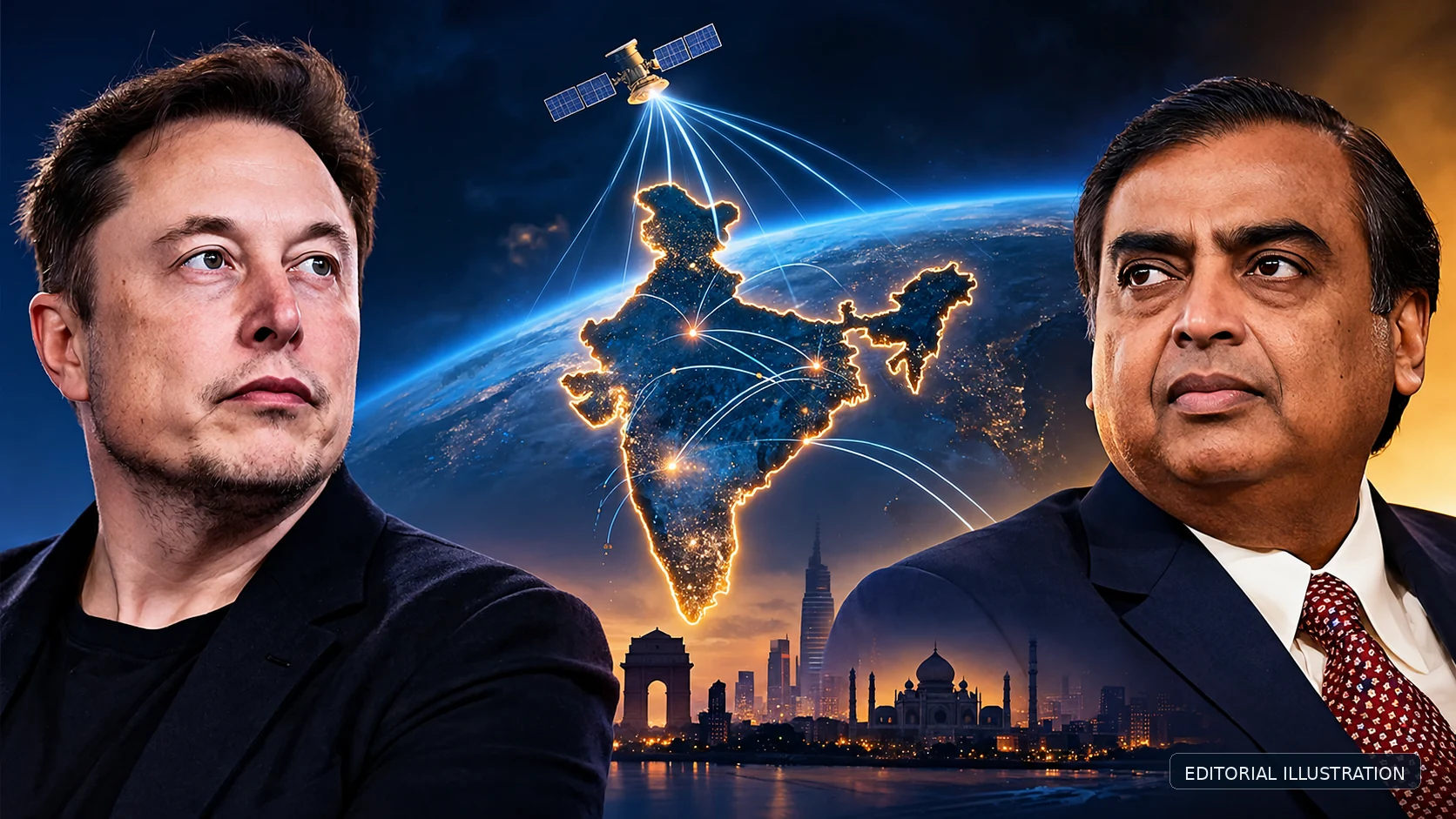
“Prime Minister Ambani” is not the name of a newly appointed Indian leader. It is the phrase Elon Musk used sarcastically in an October 9, 2026 post about Starlink’s delayed entry into India. The SpaceX chief directed the jab at Reliance Industries chairman Mukesh Ambani, arguing that powerful commercial interests were preventing satellite-internet competition. By using a government title for a businessman, Musk turned a regulatory complaint into a provocative question about political and corporate influence.
The remark was the second prominent development in a story that had already gone viral. A day earlier, Musk asked whether Ambani was the “real boss of India.” Opposition leader Rahul Gandhi entered that discussion, while India’s government rejected suggestions that licensing decisions were biased. The exchange made for dramatic headlines, but the underlying regulatory problem deserves a closer look. No reliable evidence cited here proves that Ambani determines official approvals, and India's elected prime minister is Narendra Modi.
What Elon Musk posted on October 9
Reporting by The Indian Express and India Today documented a post beginning with a mock apology to “Prime Minister Ambani.” Musk claimed that allowing Starlink to compete would challenge what he characterized as monopolistic control. He argued that people without reliable internet access, including children and small businesses, could benefit from another connection option.
The sarcasm was pointed and deliberate. It should not be rewritten as a factual claim that Ambani has constitutional authority or that India's leadership changed. It should also not be treated as proof that Reliance broke competition law. Musk made allegations about market power and licensing delays; those allegations remain disputed. An accurate headline can convey the controversy without turning an accusation into a verdict.
How the dispute developed, day by day
October 7: Musk criticized unnamed influential business interests he believed were blocking the satellite service. That provided the opening frame for the dispute: a foreign technology provider alleging obstruction in a major market.
October 8: Musk’s “real boss of India” question drew extensive attention. Rahul Gandhi answered with a remark about other powerful figures. India’s Ministry of Communications published a statement saying its satellite licensing rules were fair, security reviews were under way, and relevant companies were at broadly the same stage.
October 9: Musk returned with the “Prime Minister Ambani” post. Telecom Minister Jyotiraditya Scindia also publicly rejected the suggestion of monopoly and defended the regulatory process. The conflict shifted from a technology-business story to a subject of mainstream political debate.
October 12–13: Further reporting examined the continuing security-clearance dispute. On October 13, the Swadeshi Jagran Manch urged the government to keep Starlink out over national-security concerns. That was a demand from an organization, not proof that the government had barred the service.

What Starlink is and why India matters to it
Starlink is a satellite internet system operated by SpaceX. Its network uses satellites in low Earth orbit and customer equipment on the ground to deliver broadband service. Instead of relying entirely on a nearby fiber connection or mobile tower, a customer terminal communicates through the satellite system. This can make the technology useful in places where terrestrial infrastructure is expensive, unreliable or physically difficult to deploy.
India is a substantial potential market because it contains a large population with sharply different connectivity needs across major cities, villages, islands and mountainous regions. Some residents already have affordable fast mobile data and fiber. Others may have fewer reliable options. Satellite internet is therefore a possible complement rather than an automatic replacement for all existing networks.
Starlink’s potential advantages do not mean every Indian user would find it cheaper or faster. Retail prices, equipment fees, permitted coverage and final product conditions must be established through an actual launch. A social-media argument cannot supply those missing details.
Why a licence is not the same thing as permission to launch
One recurring source of confusion is Musk's suggestion that the company had no licence despite years of compliance. The Indian government and subsequent reporting distinguish between holding a satellite-services authorization and completing all steps required to provide commercial service. The stages include mandatory security review and, later, assignment of radio-frequency spectrum. A licensed operator may still be waiting to clear one or more of those final steps.
On October 8, India’s Ministry of Communications said it had already authorized three relevant satellite operators. According to the ministry, each was undergoing security assessment and could progress toward spectrum assignment after meeting the conditions. It said the companies were at broadly the same regulatory stage and called claims of discriminatory treatment unfounded.
There are two legitimate issues to examine without conflating them: whether the process protects users and national security, and whether the assessment is sufficiently transparent and timely. The government's statement addresses what the process is; Musk is publicly questioning why it has taken so long. Neither position, on its own, supplies a complete independent audit of every internal decision.
What did the government and Reliance say?
Communications Minister Jyotiraditya Scindia said India does not permit monopolies, disputing Musk’s characterization of the market. Reuters reported the minister’s response and noted that Musk did not provide evidence implicating Ambani in the approval process. The ministry insisted that the same framework applied to competing operators.
The Reuters report said Reliance Jio had not responded to its request for comment on Musk’s remarks at that time. That is not the same as a permanent company position, and it is not evidence of wrongdoing. Strong reporting distinguishes an allegation, a denial and an independently documented fact. The viral slogan should not erase those distinctions.
Why Jio’s earlier Starlink partnership matters
The conflict is more complicated than two companies that have never cooperated. In March 2025, Jio Platforms and SpaceX announced an agreement designed to make Starlink services available through Jio channels in India, subject to the necessary authorizations. Reliance’s 2025 press release said Jio planned to offer equipment through retail outlets and support installation and activation.
That older agreement does not settle the October 2026 quarrel. Business relationships evolve, especially when launch timelines, distribution terms and regulatory uncertainties change. It does, however, mean readers should be careful with claims that Jio and Starlink have always been enemies. They had publicly explored a commercial relationship before this confrontation.
It also helps explain why the potential Indian market is strategically interesting. A satellite provider needs a way to reach customers, deliver hardware, support installations and manage service questions. An existing national retailer can offer channels that a newer entrant would otherwise have to build.
What Rahul Gandhi’s reply added to the controversy
Rahul Gandhi reacted to Musk’s earlier “real boss” question by referring to another powerful figure, a response widely interpreted as a political criticism of the relationship between India’s leadership and big business. Musk acknowledged Gandhi’s intervention. The exchange quickly became material for party-political arguments and television coverage.
That debate may matter to voters, but it should be separated from the evidence required for a policy accusation. Neither political sarcasm nor a viral video establishes that a specific official took an improper licensing decision. For the full original exchange, read our timeline of Musk’s “Real Boss of India” question and Rahul Gandhi’s response.
Why satellite security has become the counterargument
Foreign-owned satellite networks can raise real regulatory questions. Governments want to know whether customer information is protected, whether operators can comply with lawful orders and whether communications systems can be monitored and managed during emergencies. Those questions are not unique to India, and they cannot be answered solely by comparing the number of countries in which an operator already works.
The October 13 development broadened this part of the debate. The Swadeshi Jagran Manch urged Indian authorities to block Starlink, citing national-security and data-sovereignty concerns. Reuters reported the demand. It was an advocacy position, not a final licensing order. The company’s eventual regulatory status depends on official decisions, not simply on pressure from one group.
What this means for consumers and the next stage
For customers, the important questions are practical. When will Starlink receive permission to sell service? Which parts of India will it cover? How much will the terminal and monthly subscription cost? How will speeds and reliability compare with fiber, mobile broadband and other satellite options? Which support and repair channels will operate locally? Reliable answers require formal plans and launch details, not predictions from a celebrity dispute.
For policymakers, the challenge is balancing greater network competition and rural coverage against security requirements applied consistently to every operator. For industry watchers, the next meaningful developments will be the completion of assessments, spectrum decisions, and any new statements by the companies or the Ministry of Communications. A dramatic post may focus attention, but the written approvals determine what changes on the ground.
Fact check: what the viral phrase does and does not mean
True: Musk used the phrase “Prime Minister Ambani” as a sarcastic jab, and the controversy was reported by multiple news organizations. Not established: that Ambani secretly governs India or ordered officials to block Starlink. Official position: India says its authorization and security-assessment process is non-discriminatory. Still unknown: when the commercial launch will happen, what final plans will cost and how the dispute will end.
There is room to report a viral confrontation energetically without overstating its facts. The most useful way to read this story is as a live debate about regulatory delays, market competition and the influence of powerful business figures, not as a literal reshuffling of India’s constitutional offices.
Sources and editorial disclosure
This original explainer was prepared with AI assistance and based on sources linked throughout, including India’s official government statement, Reuters, The Indian Express and Reliance’s earlier company release. It is not first-hand investigative reporting and has not been independently fact-checked on the ground. Information is current to the reporting available through October 13, 2026; later developments may change the outcome.
Frequently asked questions
Did Elon Musk say Mukesh Ambani is the prime minister of India?
Musk sarcastically addressed Ambani as “Prime Minister Ambani” in an October 9, 2026 post criticizing Starlink’s stalled India launch. He did not announce an actual change of government.
Who is the prime minister of India in October 2026?
Narendra Modi is the prime minister; Musk’s reference to Ambani was a rhetorical jab about perceived business influence.
Why has Starlink not launched commercially in India?
India says satellite operators must finish mandatory security assessments and then complete spectrum assignment. The government rejects claims that its process is discriminatory.
What did the Swadeshi Jagran Manch say about Starlink?
On October 13 it urged the government to block Starlink over national-security concerns. That appeal was not itself a government ban or licensing decision.